Healthcare OCR automation creates risk when the system cannot say, "I am not sure." A clean data response can still contain a wrong field.
Claims, enrollment forms, checks, correspondence, and attachments arrive in mixed formats. The source may be typed, handwritten, skewed, noisy, or split across pages. One weak field can delay payment, enrollment, or correspondence.
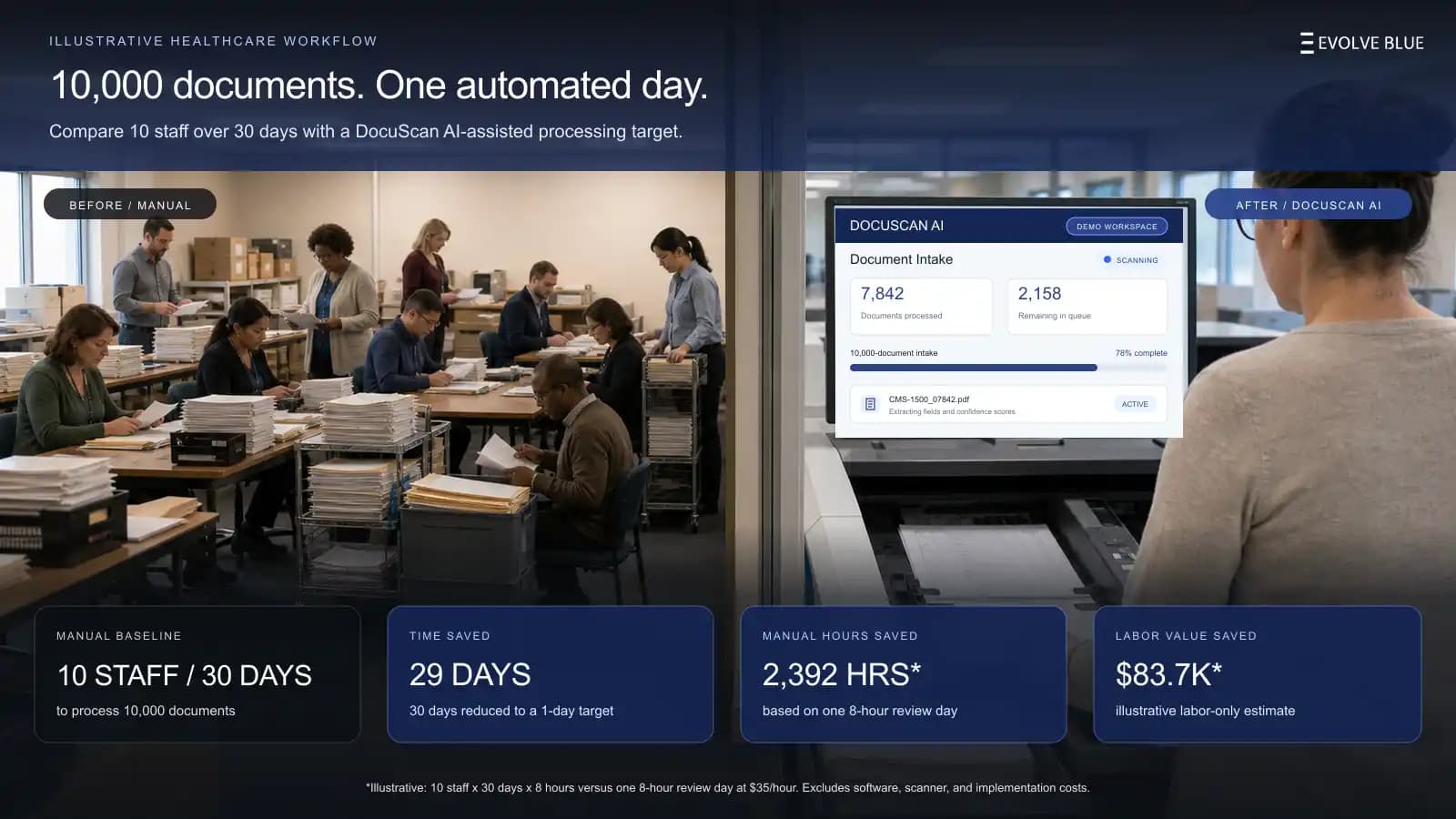
A recent healthcare demo made the requirement clear. DocuScan AI must do more than turn pages into text. It must classify, validate, score, route, export, and preserve a review trail.
Healthcare OCR needs field-level confidence
Traditional OCR returns text. Intelligent document processing adds context around that text. It identifies the document and extracts chosen fields. It also applies rules and records confidence for each result. That context separates useful automation from fast transcription.
High-confidence fields can continue through straight-through processing. Uncertain fields move into a focused review queue. Reviewers see the exception beside its source region. They do not need to reread the whole document stack. The system exposes uncertainty before the data reaches another platform.
Individual document processing removes the batch trap
Legacy engines often wait for a batch. One oversized file can hold every clean document behind it. A failed item can also force broad rework. Priority work loses its place because the queue was designed around the batch.
A healthcare queue may mix CMS-1500 claims, UB-04 forms, enrollment packets, checks, and correspondence. The demo design supports individual files of 10,000 pages or more. It pairs that scale with a 24-hour export target. DocuScan AI processes each item independently. Large files no longer need to block smaller ones.
Human review turns exceptions into evidence
Extraction is not the finish line. Rules must check formats, relationships, and required fields before export. Confidence scores then decide which results move forward. Low-confidence results wait for a person. The system should never hide that decision.
Different inputs need different controls. Noise reduction can clean a degraded scan before extraction. Table handling must preserve rows and field relationships. Handwriting often needs tighter review thresholds. Approved corrections can improve models and rules after governance checks. People keep judgment while software handles repeated reading and routing.
Parallel rollout protects healthcare operations
Healthcare OCR replacement should not begin with a hard cutover. A controlled rollout starts with discovery and configuration. Teams agree on document types, fields, rules, integrations, and acceptance measures. The new pipeline then runs beside the legacy engine. Production traffic moves only after the evidence is strong.
Teams compare accuracy, throughput, exceptions, and export timing before switching. Dashboards show queue health and service targets. Audit logs preserve actions and corrections. Role-based access and encryption protect sensitive data paths. These controls support compliance work, but features alone do not prove compliance. Policies, configuration, testing, and ongoing review still matter.
Closing view
Healthcare document processing will always contain uncertainty. The system should expose it before it becomes a claims or compliance problem. That requires more than a stronger recognition model. It requires routing, validation, review, audit, and a controlled rollout.
Good OCR reads the page. Trusted OCR knows when to stop and ask for help.