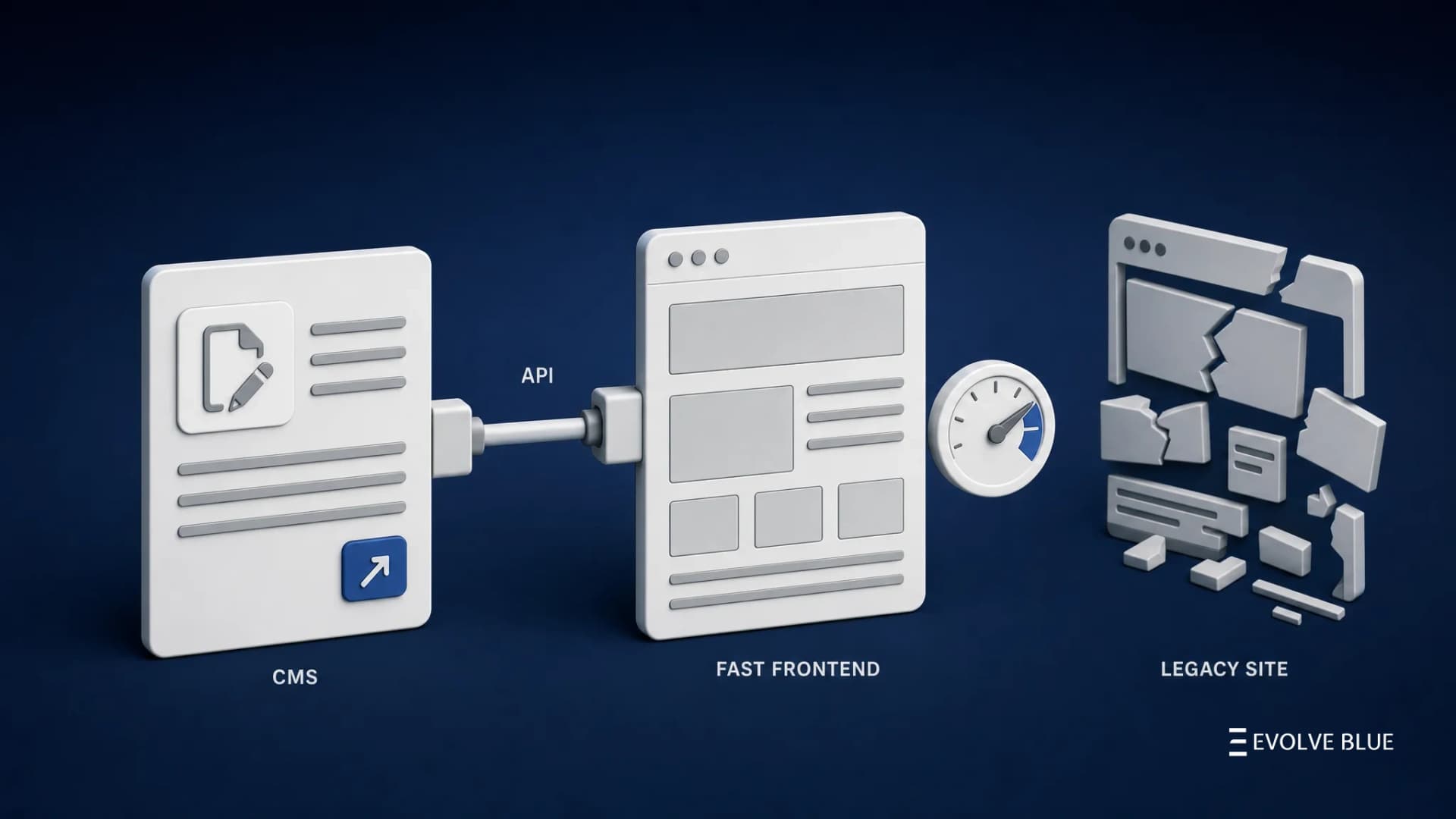
For years, the worst job in tech was untangling ancient code. Code so old the person who wrote it has grandchildren. Now AI can read it and rewrite it in days.
That sounds like great news. It is — partly. AI is fast. AI is also confident when it's wrong. It can rewrite a thousand lines while you get coffee, but it doesn't know your business. It doesn't know that one weird rule in the code exists because of a law from 2009.
So the same tool that looks like a shortcut can quietly hand you a faster version of the wrong thing. Speed only helps when you can trust where it took you.
Fast is not the same as right
AI rewrites code the way a translator works from a dictionary: fluently, confidently, and sometimes completely wrong about the intent. It sees patterns and reproduces them. It does not understand context, edge cases, or business rules buried in old workarounds.
That means you can end up with clean-looking new code that fails on the one transaction that mattered most. And nobody catches it because it passed the standard checks — it just failed the ones nobody thought to write.
Old slow code had one thing going for it
The old code had been checked. Not intentionally, not thoroughly — but tested by years of real use. Every bug that survived was a bug nobody hit yet, or one someone quietly worked around.
AI-generated code skips all of that. It looks clean, it runs, and somewhere inside it quietly does the wrong thing until the day it matters. That's not modernization. That's a faster way to break.
Speed paired with a safety net changes everything
The answer is not to avoid AI. The answer is to pair it with what AI skips: testing. Let AI do the heavy lifting — the translation, the restructuring, the volume work. Then validate every important behavior against how the old code actually ran.
If the new code does something different, you catch it now — not in production, not in front of a client. AI is the engine. Testing is the brakes. You need both to drive fast safely.
- Map every critical business rule in the old system before any rewrite begins.
- Run behavioral comparison tests: old output vs. new output, same inputs.
- Flag any divergence immediately — don't let it wait for UAT.
- Build regression coverage before you decommission the old system.
Closing view
The win isn't that AI wrote your new system. The win is that AI wrote it and you proved it works. Every line that runs unchecked in production is a bet. Make sure it's a small one.
Speed only counts when you can trust where it took you.