Canadian Medical Device Company
Healthcare
AI and IoT Platform for Glaucoma Testing
A confidential Canadian medical-device company needed the software foundation for a connected glaucoma testing device. Evolve Blue developed embedded AI capabilities, secure device-to-cloud connectivity, and a web platform that helped clinicians manage devices, patient records, and visual-field test results from one environment.
Technology Stack
01 Overview
Connected software for glaucoma testing.
The client was developing a head-mounted device designed to make visual-field testing more accessible and easier to manage.
The device required more than embedded software. Clinicians also needed a secure way to connect devices, manage patient information, review test results, and monitor testing activity remotely.
Evolve Blue developed the supporting software ecosystem: embedded AI components, IoT connectivity, and a web-based clinical management platform.
02 The Challenge
Medical-device and clinical workflow constraints to solve.
- Process visual-field test data efficiently and return useful results.
- Establish reliable communication between the physical device and cloud services.
- Give clinicians remote access to devices and completed tests.
- Manage patient records and diagnostic information securely.
- Create an interface that clinical users could understand without unnecessary complexity.
- Build an architecture that could support additional devices, users, and test volume.
- Integrate the platform into existing clinical and operational workflows.
03 The Solution
An integrated device, AI, cloud, and web architecture.
Evolve Blue developed a connected software platform around the client's head-mounted testing device.
Python-based AI components processed visual-field test information and supported real-time analysis. An IoT communication layer moved device data securely between the testing hardware and cloud services.
A React and Node.js web application gave authorized clinical users one place to manage devices, patient information, and test results. MongoDB supported the application's growing operational and clinical data needs.
Embedded AI
Python-based algorithms processed visual-field test data and supported AI-assisted analysis.
Device-to-Cloud Connectivity
An IoT layer connected testing devices with cloud services for secure data exchange and remote access.
Clinical Web Application
A React application gave clinicians access to patient records, device information, and test results.
Application Backend
Node.js services managed business workflows, device communication, authentication, and application APIs.
Data Management
MongoDB supported patient, test, device, and operational information within a scalable data model.
Remote Device Management
Authorized users could review device activity and test information without being physically connected to the testing unit.
04 What We Built
Glaucoma testing platform components delivered.
Build embedded AI components for visual-field test processing.
Connect medical devices with cloud services through an IoT communication layer.
Create a React-based clinical and device-management portal.
Develop Node.js APIs for application and device workflows.
Support patient-record and test-result management.
Create a scalable data architecture on MongoDB.
Design workflows for clinical and operational teams.
05 Clinical Platform Showcase
Glaucoma testing platform in a clinical desktop view.
The desktop showcase presents the connected clinical platform: AI-assisted analysis, device status, test-result visibility, and remote workflow support in one environment.
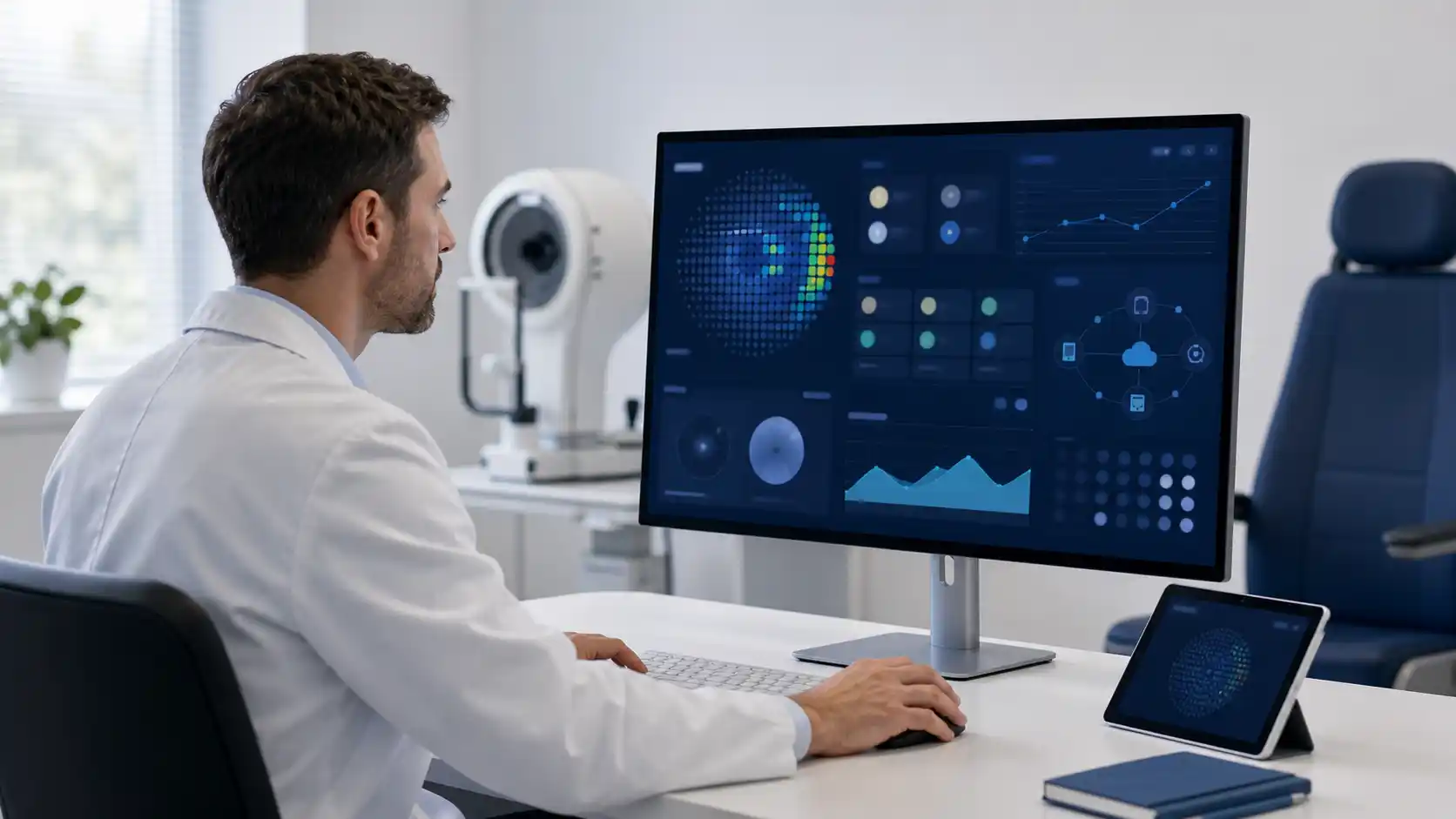
AI-assisted visual-field testing, connected device status, and clinical workflow visibility in one platform view.
06 Implementation Journey
Device, AI, cloud, and web implementation journey.
Discovery
Reviewed the device workflow, clinical use cases, user roles, data requirements, and connectivity constraints.
Architecture
Defined the interaction between the embedded AI layer, device communication services, backend APIs, database, and web application.
Application Development
Built the AI components, IoT services, backend APIs, and clinician-facing web application as an integrated platform.
Integration and Testing
Connected the physical-device workflow with cloud services and validated the movement of test and device information across the platform.
Handoff and Expansion
Structured the system so the client could continue adding devices, clinical workflows, and platform capabilities.
07 Before / After
From device workflow to connected diagnostic platform.
The engagement connected device communication, AI-assisted analysis, patient information, and clinical test workflows in one software foundation.
Device without a platform
The medical device lacked a complete connected software ecosystem for remote access, device management, patient records, and test results.
Connected clinical platform.
Devices could communicate with cloud services while clinicians managed patients, devices, and visual-field test results in one application.
Before
- The medical device lacked a complete connected software ecosystem.
- Test information was tied closely to the physical testing workflow.
- Clinicians had limited remote access to device and test information.
- Device management, patient information, and test results were not unified.
- Scaling to additional devices and clinical users would have created operational friction.
After
- Devices could communicate securely with cloud services.
- AI components supported faster processing of visual-field test information.
- Clinicians could manage devices, patients, and test results through one web application.
- Authorized teams could access information remotely.
- The platform provided a scalable foundation for additional devices and workflows.
08 Impact
Connected diagnostic workflow outcomes.
Connected diagnostic workflow
The device became part of a broader digital platform instead of operating as isolated hardware.
Faster access to test information
Clinical users could review completed tests and related patient information through a centralized application.
Remote operational visibility
Authorized teams gained visibility into device activity and testing workflows without requiring local device access.
Scalable software foundation
The architecture could support growing numbers of devices, users, patients, and completed tests.
Simpler clinical experience
The platform consolidated device management and test workflows into a more understandable interface.
09 Capability Mapping
Capabilities applied for connected medical-device delivery.
Build & Modernize
PrimaryDeveloped embedded software components, backend services, data architecture, and a clinician-facing web application.
Connect Data & Platforms
PrimaryConnected physical medical devices, cloud services, application APIs, and clinical data workflows.
Automate Workflows
PrimaryAutomated the movement and processing of device and test information across the platform.
Run Cloud & Operations
SupportingCreated the cloud-connected foundation required for remote access, platform scale, and ongoing operations.
Staff & Augment
SupportingThe engagement was delivered as a technology project rather than a staffing assignment.
10 Conclusion
Why this healthcare technology engagement mattered.
Building a connected medical device requires more than hardware and an algorithm. The device, application, data, connectivity, and clinical workflow must operate as one system.
Evolve Blue developed the software foundation around the client's glaucoma testing device, connecting embedded AI, IoT services, clinical data, and a scalable web application.
The result was a more connected diagnostic workflow and a stronger platform for future product growth.
More Client Work
Explore related case studies.
See how Evolve Blue solves similar delivery problems across industries.
Build connected healthcare technology.
Evolve Blue helps healthcare and medical-device companies build AI-enabled applications, connected-device platforms, clinical workflows, and secure data integrations.